The Arterial Review
Cardiovascular Health · Independent Reporting
Heart Health
They Cut Open 257 Clogged Arteries. In 150 of Them, They Found Plastic.
A 2024 paper in The New England Journal of Medicine found polyethylene lodged inside human artery plaque — and the patients who had it fared far worse over the next three years. Here is what that has to do with the pot on your stove.
Sponsored by BloodPril. This article is paid advertising, produced and paid for by the seller of the product it describes. Product links are commercial.
If you are past 55 and your blood pressure readings have refused to budge — after you cut the salt, after you started the morning walk, after the second prescription got added — there is a piece of research from last year that almost certainly never came up at your appointment.
In February 2024, a research team led by Dr. Raffaele Marfella at the University of Campania in Italy published a study in The New England Journal of Medicine. They enrolled 257 patients who were already scheduled to have plaque surgically scraped out of the carotid artery — the big vessel in the neck that feeds the brain. Instead of discarding that tissue, they ran it through mass spectrometry and electron microscopy.
They were not looking for cholesterol. They already knew cholesterol was there.
They were looking for plastic.
150 of 257Roughly 58% of the plaque samples contained polyethylene — the plastic used in food packaging, grocery bags, bottle caps and the liners of takeout containers. A smaller group also contained PVC. Under the microscope, the particles appeared as jagged foreign fragments embedded in the plaque, ringed by inflammatory cells.
Then the researchers followed those patients for just under three years. The ones with plastic in their plaque went on to have a heart attack, a stroke, or died at a rate roughly 4.5 times higher than the patients whose plaque came back clean.
Sit with that for a moment. Same artery. Same surgery. Same hospital, same country, same year. The single variable that separated the two groups was whether their arterial plaque had plastic in it.
The authors were careful, as good researchers are, to say the study shows an association and not proof of cause. That caution is warranted. But it is also the first time anyone has pulled plastic out of a living human's artery wall and then watched what happened to that person afterward — and the finding was strong enough that the journal ran an accompanying editorial about it.
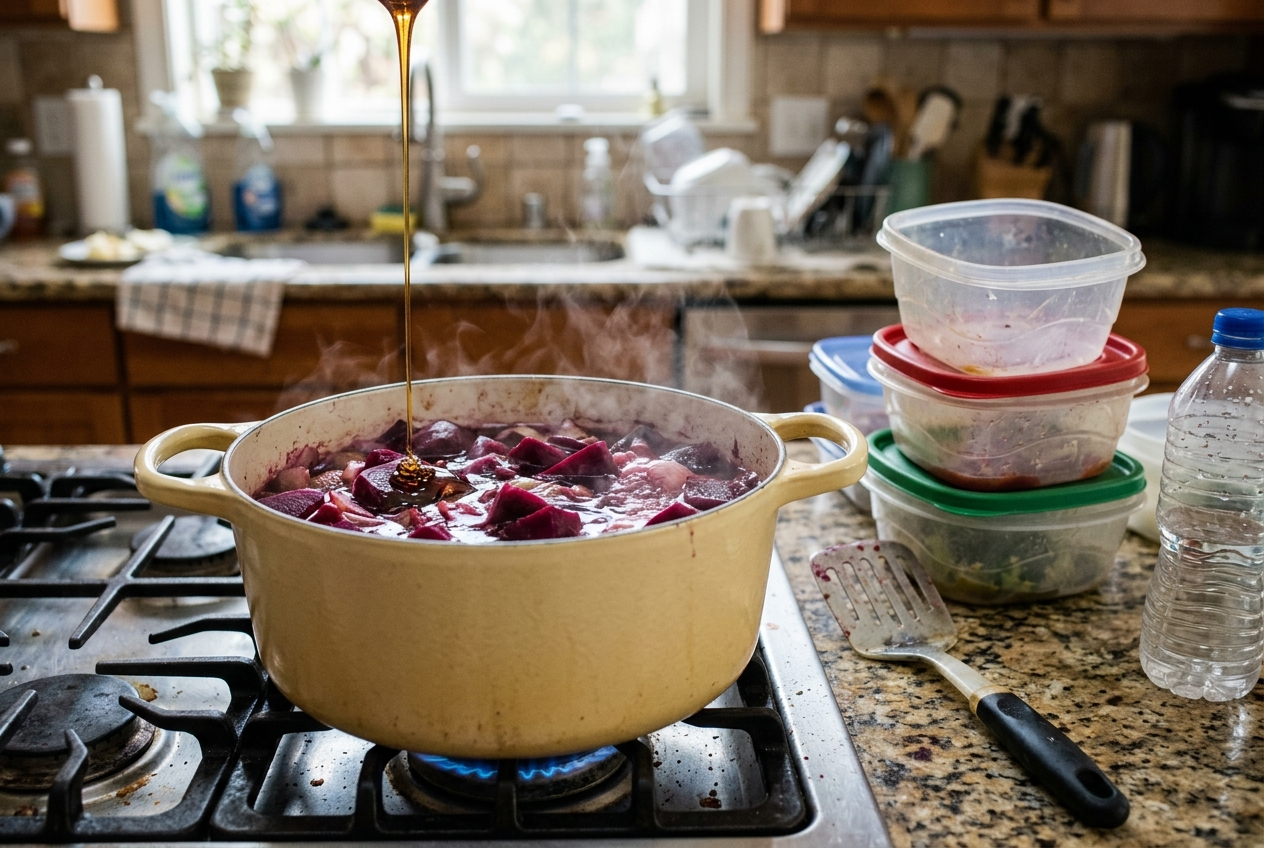
The exposure is not exotic. For most Americans it is measured in degrees Fahrenheit, in their own kitchen.
What a foreign particle does to a blood vessel
To understand why this matters for your readings, it helps to stop picturing an artery as a pipe.
A healthy artery is closer to a garden hose. It is muscular and elastic. Every time your heart beats, the artery flexes outward to absorb the surge, then springs back to push the blood along. That springiness is doing an enormous amount of the work. When it is intact, your heart gets to push against something forgiving.
A stiff artery does not absorb the beat. It transmits it — and your heart has to push against a copper pipe instead of a hose.
Arterial stiffness is not a fringe idea. It is one of the most-studied measurements in cardiovascular medicine, and it climbs with age in almost everyone. What drives it is a slow accumulation on and inside the vessel wall: fibrous tissue, calcium that has migrated out of the bloodstream and settled where it does not belong, and — as of 2024 — particles that the body has no disposal route for.
The inflammatory ring the Italian team photographed around those plastic fragments is the part worth understanding. Your immune system recognizes a foreign object. It cannot dissolve it and it cannot excrete it. So it does the only other thing it knows how to do: it walls it off. Layer by layer. And every layer of that walling-off is one more millimeter of vessel that no longer flexes.
Why “just cut the salt” stopped working for so many people
Salt is not innocent, and nobody serious is claiming otherwise. But the salt-first model has always had an awkward gap in it, and anyone who has lived it knows exactly what the gap looks like.
It looks like the neighbor who salts everything, eats what he likes, and has never had a reading over 118. And it looks like you — the one who threw out the shaker, who reads every label, who walks the loop every morning, who takes the pill at the same hour every day — watching the cuff deflate and show you the same number it showed you last year.
People in that second group tend to describe the same handful of things: a dull pressure at the back of the neck that painkillers do not touch, a moment of grey when standing up too fast, a ringing that comes and goes, and getting winded on a flight of stairs that used to be nothing. Those are the symptoms that send people looking for answers on the internet at eleven at night.
If a meaningful part of vessel stiffening is being driven by an accumulation that has nothing to do with the salt shaker, then doing the salt part perfectly was never going to close the gap. You were doing the right homework for a different exam.
Doing everything right and watching the number hold steady is the most common version of this story.
Where it gets in: six things worth changing this week
None of this requires buying anything. These are the exposure routes with the best evidence behind them, and they are almost all kitchen routes, because heat and fat are what pull particles out of plastic and into food.
- Stop microwaving in plastic. This is the single biggest one. Heating food in a plastic container is the highest-release scenario documented. Transfer to glass or ceramic first — it costs you one extra dish.
- Never pour something hot into plastic. Soup into a takeout tub, coffee into a travel mug with a plastic liner, hot leftovers into a storage container before they cool. Let it come down to room temperature first.
- Retire scratched nonstick cookware. An intact coating is one thing; a coating that is flaking, chalky, or scored by a metal utensil is shedding into the pan. If you can see the scratches, it has finished its career.
- Get off single-use bottled water at home. Bottled water has been measured at dramatically higher particle counts than filtered tap. A carbon or reverse-osmosis filter and a glass or steel bottle solve it permanently.
- Skip the plastic kettle and the plastic-lined cup. Anything that holds near-boiling liquid should be glass, steel, or ceramic.
- Do not leave bottles in a hot car. A closed car in summer runs hot enough to accelerate release substantially.
Do those six and you meaningfully reduce what is coming in. What none of them do is help with what has already accumulated over forty years of ordinary American eating — which is the question the rest of this article is about.
The place where this does not seem to happen
There is a region of the world that has been irritating cardiovascular researchers for about twenty-five years, because it should not exist.
The Ogliastra province, in the mountainous interior of Sardinia, has one of the highest concentrations of male centenarians ever documented — a place where men reaching a hundred is common enough to be unremarkable. It is one of the handful of regions that got labeled a “blue zone.”
What makes it awkward is the diet. These are not people eating steamed vegetables and avoiding salt. They eat aged sheep's cheese. They cure and eat pork. They salt their food. They drink red wine daily, in the afternoon, without guilt. Every lifestyle lever American cardiology has been pulling for fifty years, Ogliastra pulls in the opposite direction — and their vessels age more slowly anyway.
Which suggests the interesting question is not what they avoid. It is what they take in that most of us never do.
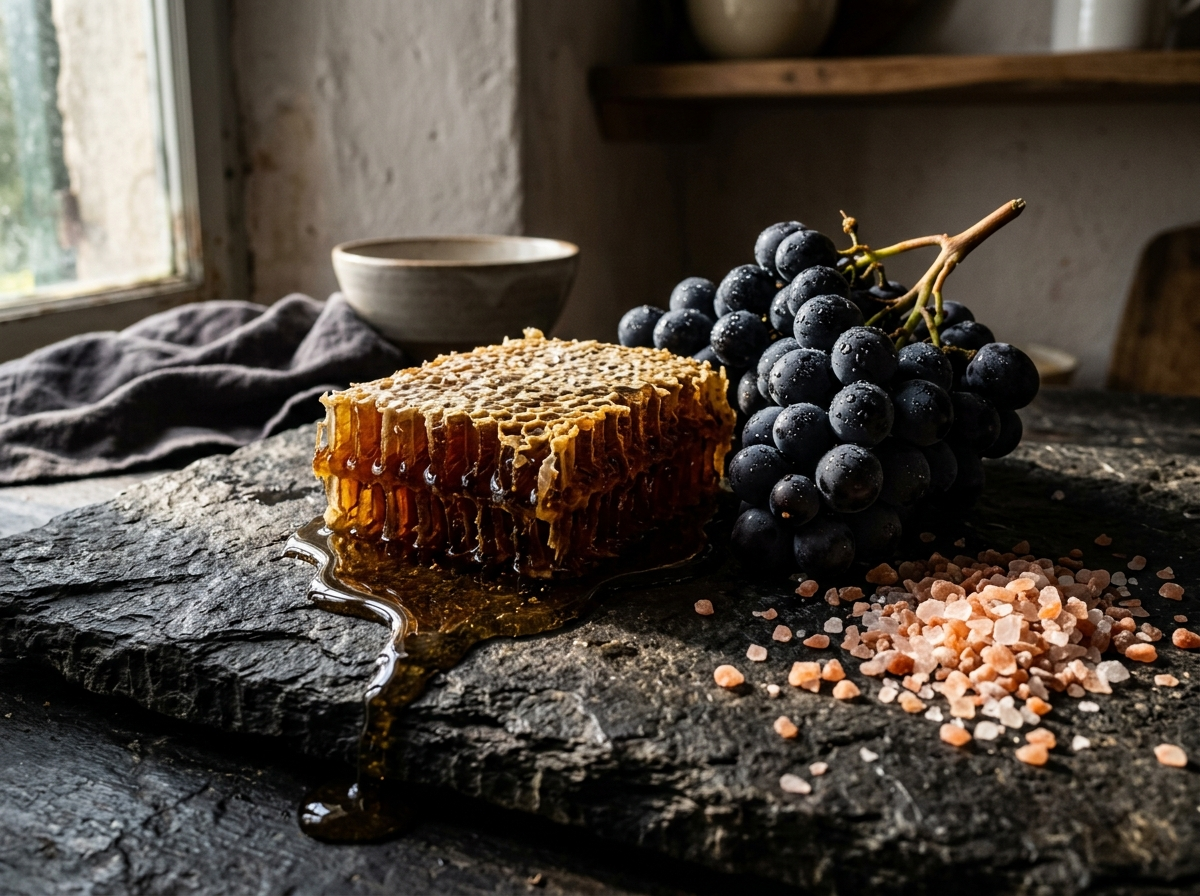
Four things that show up on an Ogliastra table almost daily — and almost never on an American one.
Four things on a Sardinian table
1. Bitter honey from the strawberry tree
Corbezzolo · Arbutus unedo
It tastes nothing like the honey in the plastic bear. It is dark, resinous, and genuinely bitter — a taste most Americans reject on the first spoon. The bitterness has a chemical signature: homogentisic acid, which chemists use as the marker compound to authenticate real corbezzolo honey because it is not detectable in other monofloral honeys at all. It is produced for roughly three months a year, only where the shrub grows wild, which is why it has never had a real American distribution channel.
2. Cannonau grape
Polyphenols · nitric oxide
The Cannonau has been cultivated on the island for thousands of years, in thin soil and hard sun — conditions that push a grape to thicken its skin and load it with defensive compounds. When researchers went looking for which of the world's wines carried the highest concentrations of vascular-active procyanidins, Sardinian wines came out at the top of the list alongside those of southwest France. Grape polyphenols are among the best-studied dietary supports for the body's own production of nitric oxide — the molecule the vessel wall releases to tell itself to relax and widen.
3. Vitamin K2, in the MK-7 form
Pecorino Sardo · aged sheep's milk
This is the one that surprises people, because it is a story about calcium going to the wrong address. K2 activates the proteins that direct dietary calcium into bone and away from soft tissue. In a three-year randomized controlled trial in 244 postmenopausal women, daily MK-7 supplementation was associated with improved arterial stiffness measures compared with placebo — with the clearest effect in the women who started out stiffest. Aged sheep's cheese is one of the densest natural sources in the Western diet, and American diets, built on fresh dairy and leafy greens, are comparatively poor in it.
4. The support layer
Magnesium · CoQ10 · Vitamin D3
Less romantic, better documented — and worth being precise about, because the numbers are modest. Pooling 34 randomized double-blind trials, magnesium supplementation lowered systolic pressure by about 2 mmHg and diastolic by about 1.8 mmHg. That is real, and it is small. CoQ10 has a thinner file than its reputation suggests: the most-cited meta-analysis pooled 12 studies, but only three of them were randomized controlled trials. D3 supports normal calcium handling and works alongside K2, which is why the two are almost always paired. None of these are the story — they are the conditions that let the story work.
Now the part most pages like this leave out
The company paying for this article sells a daily cardiovascular supplement called BloodPril. You should know exactly what that is and exactly what it is not, because the distinction matters more at 60 than it does at 30.
It is a dietary supplement. It is not a drug, it is not a treatment, and it has not been through the FDA approval process that a prescription medication goes through. It is formulated to provide targeted nutritional support for heart health, healthy blood pressure already within a normal range, and general cardiovascular wellness.
It does not replace anything your doctor prescribed. If you are on a blood pressure medication, keep taking it exactly as prescribed. Do not reduce it, do not skip it, and do not stop it because of something you read on the internet — including this page. Any change to a prescription is a conversation with your physician, full stop. Anyone who tells you otherwise is selling you something at a cost you cannot see yet.
It is not a substitute for the six changes above. Those are free and you should do them regardless of whether you ever buy anything from anyone.
If that framing sounds less exciting than what you usually see in an ad, that is deliberate. It is also the reason this page exists instead of a more aggressive one.
Why this comes in a bottle instead of a grocery list
The obvious question, after reading all that, is why you would not simply go buy the four things.
Because for an American, three of them are effectively unavailable. Corbezzolo honey is produced for about three months a year in one mountain region and has never had a real US distribution channel. Cannonau extract concentrated for polyphenol content is not a supermarket item. And while aged sheep's cheese carries K2 as MK-7, Pecorino Sardo is not something most American kitchens keep on hand — the American diet, built on fresh dairy and leafy greens, is comparatively poor in that form of the vitamin to begin with. The magnesium, CoQ10 and D3 you can buy anywhere, which is precisely why they are the support layer and not the story.
That gap is the argument for a formula: putting the hard-to-source inputs into one thing you take in the morning, without a shopping trip to Sardinia.
BloodPril is the version this article's sponsor makes. It is a capsule, taken daily, manufactured in the United States from globally sourced ingredients, and formulated to provide targeted nutritional support for heart health, healthy blood pressure already within a normal range, and general cardiovascular wellness.
What is in it
- Sardinian bitter honey — Arbutus unedo (corbezzolo), standardized for homogentisic acid
- Cannonau grape extract — skin and seed, standardized for cardioprotective polyphenols
- Vitamin K2 as MK-7 — sourced from Pecorino Sardo
- Endothelial renewal complex — a bioactive peptide blend
- Coenzyme Q10
- Magnesium
- Vitamin D3
The full Supplement Facts panel, with the amount of each ingredient per serving, is printed on the bottle and shown on the product page.
Every package carries a 60-day satisfaction guarantee. If you have used it consistently for at least 30 days and are not satisfied, contact customer service and they will make it right.
One honest note about the longer packages, since nobody else will say it: the reason they cost less per bottle is not a trick, but it is also not urgency. Arterial stiffness is a slow measurement. Nothing in the research on these compounds is framed in days — the MK-7 trial that moved arterial stiffness measurements ran for three years. If you are going to try this at all, trying it for two weeks tells you nothing.
Ships from the USA · 60-day satisfaction guarantee · No subscription, no auto-billing
And if you close this page and buy nothing, do the six kitchen changes anyway. They cost nothing and they are the part of this you control completely.
Advertising disclosure. This page is an advertisement, not independent editorial content. It was written for and paid for by the seller of BloodPril, the product described. If you purchase through a link on this page, the publisher may earn a commission.
Health disclaimer. These statements have not been evaluated by the Food and Drug Administration. This product is not intended to diagnose, treat, cure, or prevent any disease. The content on this page is for general informational purposes only and is not medical advice. It is not a substitute for consultation with a qualified healthcare professional. Never disregard professional medical advice, or delay seeking it, because of something you read here. Do not start, stop, or change any prescription medication without speaking to your physician. If you are pregnant or nursing, have a diagnosed medical condition, or take prescription medication — particularly anticoagulants, which interact with vitamin K — consult your doctor before using any dietary supplement. If you experience chest pain, sudden weakness, difficulty speaking, or severe headache, call 911.
Results disclaimer. Individual results vary and depend on factors including diet, activity, age, and adherence. No individual outcome should be understood as typical or expected. Any testimonials shown are the genuine experience of the individual quoted, used with permission, and are not representative of what any other person will experience.
Research citations. The studies below are linked to their published sources. They were conducted on individual compounds or dietary patterns, not on BloodPril, and they do not constitute evidence about the finished product. Neither the cited researchers nor their institutions are affiliated with, endorse, or have any connection to BloodPril or its seller.
BloodPril
Grupo Ether LLP · Partnership No. OC460232
71-75 Shelton Street, Covent Garden, London, WC2H 9JQ, United Kingdom
Customer service: +55 71 99968 4542 ·
ogrupo.ether@gmail.com
Privacy Policy
·
Terms of Service
·
Refund Policy
·
Contact Us
Copyright © 2026 Grupo Ether LLP. All rights reserved.
- Marfella R, Prattichizzo F, Sardu C, et al. Microplastics and Nanoplastics in Atheromas and Cardiovascular Events. N Engl J Med. 2024;390(10):900-910. doi.org/10.1056/NEJMoa2309822
- Poulain M, Pes GM, Grasland C, et al. Identification of a geographic area characterized by extreme longevity in the Sardinia island: the AKEA study. Exp Gerontol. 2004;39(9):1423-1429. pubmed.ncbi.nlm.nih.gov/15489066
- Cabras P, Angioni A, Tuberoso C, et al. Homogentisic acid: a phenolic acid as a marker of strawberry-tree (Arbutus unedo) honey. J Agric Food Chem. 1999;47(10):4064-4067. doi.org/10.1021/jf990141o
- Corder R, Mullen W, Khan NQ, et al. Oenology: red wine procyanidins and vascular health. Nature. 2006;444(7119):566. nature.com/articles/444566a
- Knapen MHJ, Braam LAJLM, Drummen NE, et al. Menaquinone-7 supplementation improves arterial stiffness in healthy postmenopausal women. A double-blind randomised clinical trial. Thromb Haemost. 2015;113(5):1135-1144. doi.org/10.1160/TH14-08-0675
- Zhang X, Li Y, Del Gobbo LC, et al. Effects of magnesium supplementation on blood pressure: a meta-analysis of randomized double-blind placebo-controlled trials. Hypertension. 2016;68(2):324-333. doi.org/10.1161/HYPERTENSIONAHA.116.07664
- Rosenfeldt FL, Haas SJ, Krum H, et al. Coenzyme Q10 in the treatment of hypertension: a meta-analysis of the clinical trials. J Hum Hypertens. 2007;21(4):297-306. doi.org/10.1038/sj.jhh.1002138